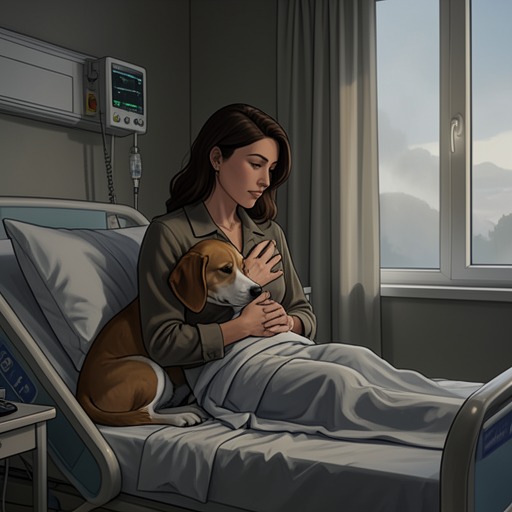
Molly Learns to Signal Cancer Odors and Joins the Detection Program
A Dog's JourneyMolly Learns to Signal Cancer Odors and Joins the Detection Program is the turning point in which a scent she first encountered as Buddy becomes a learned, communicable alert. At Andi’s dog rescue, Molly watches Luke signal during cancer-detection exercises, recognizes an odor that recalls her earlier life, and adopts the same crossed-paws posture. Her discovery makes her not merely a dog with an unusually sensitive nose, but a participant in a practical effort to bring canine cancer detection directly to people.
The Rescue and Its Research
Andi explains that the facility’s main purpose is dog rescue, but a grant also allows her to research cancer detection. She describes canine smell as potentially a hundred thousand times more intense than human smell and cites studies suggesting that dogs can detect cancer on a person’s breath before other diagnoses have been made. The promise of earlier detection gives the work its urgency: Andi is trying to put existing study methods into practice, not simply demonstrate that dogs can smell unusual things.
The program’s intended setting distinguishes it from much of the research Andi describes. Many trainers work with specimens in a laboratory, asking dogs to sniff test tubes. Andi wants to see whether dogs can work in the field, moving from person to person at places such as health fairs or community centers. She imagines detection as an encounter between a trained dog and members of the public, rather than as a task confined to samples and laboratory equipment.
That ambition depends on routine care as well as research. Andi’s employees are unavailable for different reasons, and the volunteers she has are more drawn to walking dogs than cleaning kennels. CJ joins her at the facility and takes on work that includes caring for the dogs; Andi presents the help as a way to free her for training. CJ’s participation can also count toward her community service. The program therefore links its prospective public benefit to ordinary, often unglamorous labor inside the rescue.
Learning by Watching Luke
Molly’s first exposure to the detection exercises is indirect. While CJ cleans kennels and Molly plays with dogs in an indoor area, she watches Andi work with Luke, a large brown male, and two female dogs. People sit apart in metal chairs, and Andi leads the dogs to them one at a time. After each round, the dogs return to their kennels while the people change seats. The arrangement makes each approach a new opportunity to investigate a person by smell.
Luke’s response supplies Molly with a visible model. When he reaches a bald man, he carefully sniffs, lies down, crosses his front paws, and rests his head on them. Andi rewards him immediately and praises him. Molly imitates the posture in hopes of receiving a treat, but neither Andi nor CJ treats the gesture as a successful alert. The episode establishes a difference between copying a trained dog’s action and using that action in response to the relevant scent: Molly has learned the form before she has learned its purpose.
A related recognition occurs outside. A bald man speaks with CJ about how old she was when she started smoking, and Molly approaches him after he has gone back inside. His breath carries a metallic tang that she recognizes from the bad taste she experienced as Buddy. She does not yet make a trained signal in response. Instead, the encounter joins an old bodily memory to the smell now appearing in Andi’s work, before Molly has fully understood what the game is testing.
Recognizing the Odor and Making an Alert
Molly’s understanding becomes clearer during a later session. Andi leads her and CJ from one seated person to the next. Molly encounters different smells, including fur boots that smell of cats and a person’s tangy fingers. At a woman whose hands smell of fish, however, she detects the same odor she remembers from Buddy’s mouth and from the bald man’s breath. The recognition is sensory before it is explained: Molly identifies the recurring smell through her own experience.
As Andi begins to move on, Molly senses a slight tension in her and realizes that the odor is what the exercise concerns. She turns back to the woman, lies down, and crosses her front paws. This time the gesture is tied to the scent rather than performed merely in imitation. Andi responds with excitement, praises Molly, and gives her treats. For Molly, the reward makes the game welcome; for the program, her response supplies evidence that she can connect an odor to the signal trainers are trying to teach.
Andi does not present Molly’s performance as simple instinct. She thinks dogs may detect the odor without necessarily understanding that they should communicate what they have detected. In her view, Molly has watched Luke and learned his way of signaling; she says she has never heard of a dog learning the behavior by watching another dog. The episode thus makes social learning part of Molly’s success: smell gives her information, while observation provides a legible action through which she can convey it to a human handler.
Joining the Program
After the successful alert, Andi asks whether Molly can take part in the program and whether CJ is interested as well. She explains that the work can count toward CJ’s community service. CJ jokes about giving up shoveling dog waste, but does not immediately commit. The invitation nevertheless marks a change in Molly’s position at the rescue: she is no longer only a companion playing among the dogs while CJ works, but a dog whose responses Andi wants to incorporate into training and field practice.
From then on, during visits with Andi, Molly meets people and signals when she detects the unusual odor. Such occasions are uncommon; most people simply smell like people. That qualification matters. The narrative does not portray her as signaling indiscriminately or as diagnosing everyone she encounters. Her task is a selective response to a particular scent, performed within a program that is still putting detection methods into practice.
The training also contrasts Molly’s reward with Luke’s established role. She had watched him receive a treat for the crossed-paws signal, and her first imitation won no attention. Once she makes the same gesture in response to the relevant smell, Andi recognizes and rewards it. The repeated posture becomes a shared code between dog and trainer: an internal perception, inaccessible to the people in the room, is converted into an outward action they can notice.
A Skill Carried Forward
The importance of Molly’s alert extends beyond her sessions with Andi. In a later life as Max, she detects a metallic, unmistakable odor on Trent’s breath while he is preparing the dog’s food and signals as she was trained to do. CJ eventually understands that Max’s earlier behavior had been an attempt to warn them about Trent’s cancer; she tells Max that the cancer was caught in time and had not returned. This later recognition gives the training a concrete consequence while preserving the delay at its heart: the dog’s signal came before the people around him understood what it meant.
CJ’s understanding also reaches back to Molly. She wonders whether Molly had somehow told Max what to do and calls Molly an angel dog, while Max responds to the name by wagging. The narrative leaves the communication between the dogs unexplained, but makes the continuity of the alert meaningful: a bodily skill learned through Molly’s smell and observation can be recognized later as part of a continuing bond and a life-saving warning.
The episode’s account of detection rests on knowledge that precedes verbal explanation. Molly first experiences the odor as taste and smell, recognizes its recurrence, watches another dog’s behavior, and only then makes a signal a human can interpret. The program gives that canine perception a practical structure without making it infallible or frequent. Its significance lies in joining sensory attention to learned communication—and in showing how care can begin with a warning that people do not yet know how to read.